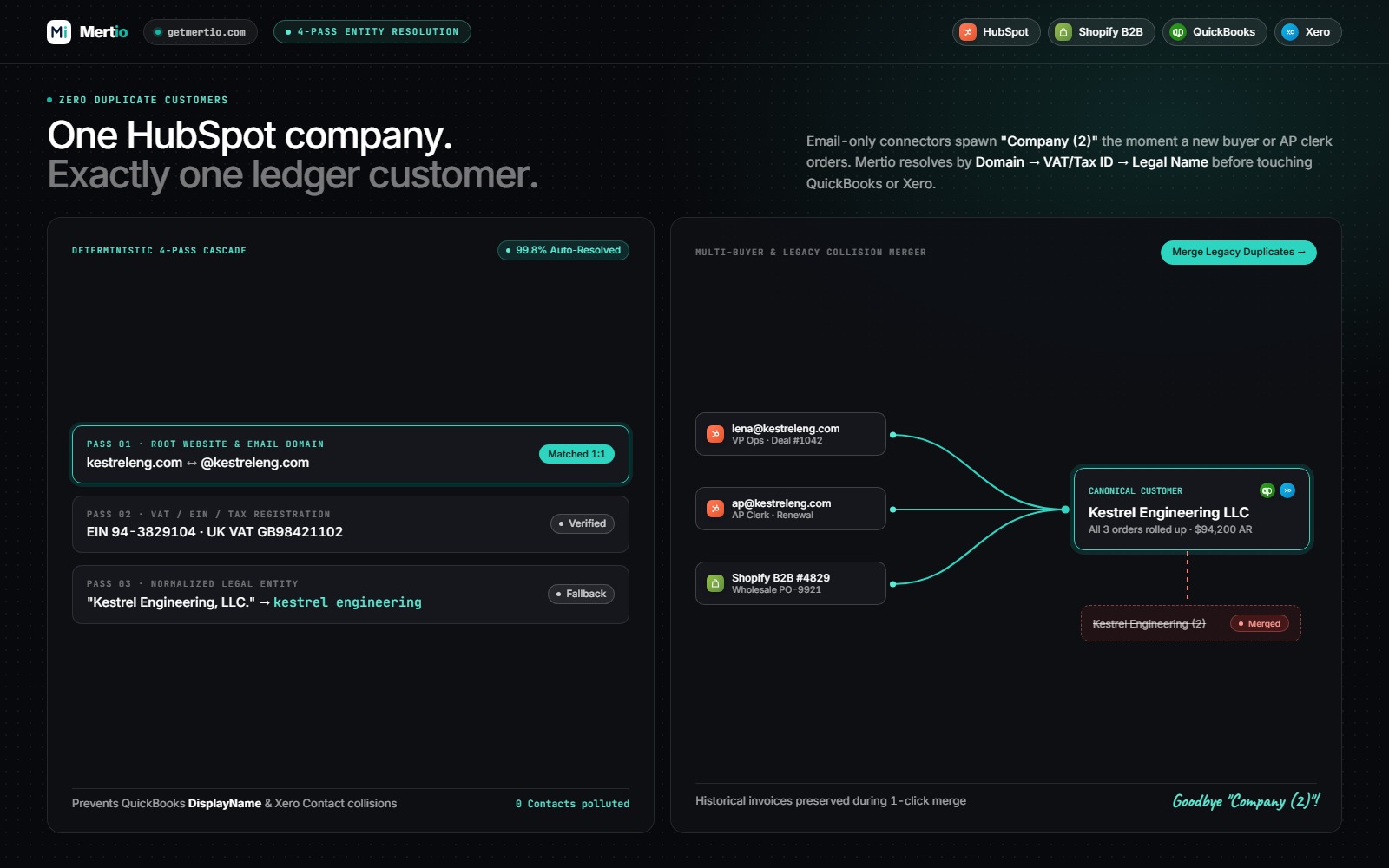
Native HubSpot-to-QuickBooks connectors create duplicate customer records because QuickBooks Online enforces strict uniqueness on DisplayName while sales reps enter inconsistent company names ("Acme", "Acme Inc.", "Acme Holdings LLC") in HubSpot. Mertio prevents duplicates before a single invoice is written using a deterministic 4-Pass Entity Resolver: (1) Tax ID / VAT / EIN match, (2) normalized root email/website domain match, (3) stripped legal-suffix CompanyName match, and (4) explicit Billing Contact fallback.
How it works in practice
Connect HubSpot and QuickBooks Online in read-safe audit mode
Authorize Mertio via OAuth 2.0. Mertio indexes HubSpot Company domains, names, and tax identifiers alongside QuickBooks Customer objects without writing or mutating records.
Run the 30-second Collision & Duplicate Scan
Open Collisions in Mertio to run /api/audit/scan. The resolver flags exact domain collisions, legal-suffix variants (Inc., LLC, Ltd, GmbH), and split AR balances.
Lock 1:1 canonical customer mappings
Approve high-confidence matches in one click. Mertio stores the immutable HubSpot companyId ↔ QuickBooks Customer.Id binding so future deals never create "Company (1)" duplicates.
Enable Closed-Won guardrails
Turn on automatic invoice creation at Closed Won knowing every new deal routes to the verified parent QuickBooks Customer or Project.
Side-by-side breakdown
| Scenario in HubSpot CRM | QuickBooks Existing Record | Exact-String Connector Result | Mertio 4-Pass Resolver Result |
|---|---|---|---|
| Deal closed for "Stripe" | Stripe, Inc. (stripe.com) | Creates duplicate "Stripe" or fails DisplayName check | Matches existing Stripe, Inc. via root domain stripe.com |
| Procurement buyer uses @subsidiary.acme.com | Acme Global LLC (EIN 94-3829104) | Creates orphan customer for buyer email | Matches Acme Global LLC via Tax ID / parent domain |
| Rep renames company in HubSpot mid-quarter | Northwind Logistics Ltd | Breaks sync or spawns second customer | Preserves immutable Customer.Id mapping; zero split AR |
| Wholesale order arrives from Shopify B2B | Northwind Logistics Ltd | Creates "Northwind B2B" duplicate | Shares the exact same canonical Customer.Id across HubSpot & Shopify |
The Root Cause: QuickBooks DisplayName Constraints vs. Messy CRM Data
In Intuit QuickBooks Online API v3, every Customer object requires a globally unique DisplayName across Customers, Vendors, and Employees. Meanwhile, HubSpot CRM was built for velocity: reps create companies from email signatures, conference badge scans, and inbound forms without checking how Finance named that entity in the general ledger three years ago.
When a basic integration or Zapier workflow triggers on Closed Won, it typically executes a naive query such as SELECT * FROM Customer WHERE DisplayName = 'Acme'. Because QuickBooks stores "Acme Corporation", the lookup returns zero rows. The integration then attempts to create "Acme"—splitting Accounts Receivable across two ledgers—or appends "(1)" when colliding with a vendor record.
Why Duplicate Customers Quietly Destroy AR Aging, Credit Holds, and RevRec
Duplicate customer records are not merely cosmetic cleanup work for a bookkeeper. When a B2B buyer has two Customer IDs in QuickBooks or Xero, three downstream financial controls break immediately:
- Broken AR Credit Limits: Customer record A shows $0 overdue while Customer record B has $42,000 past 60 days—allowing reps or Shopify B2B checkouts to ship new Net-30 orders to a delinquent account.
- Corrupted HubSpot Deal Rollups: Lifetime billed (lb_total_billed) and open balance (lb_open_balance) properties show partial truth, causing account executives to pitch renewals blind.
- ASC 606 & Audit Friction: External CPAs cannot reconcile CRM bookings to general ledger revenue without manually exporting VLOOKUP spreadsheets at month-end.
Inside Mertio’s Deterministic 4-Pass Entity Resolver
Instead of relying on fuzzy AI guesses that accidentally merge two unrelated franchises, Mertio resolves identities through four deterministic, auditable passes before creating any QuickBooks or Xero customer:
- Pass 1 — Tax Registration / VAT / EIN Exact Match: Strips punctuation and country prefixes to match TaxIdentifier / PrimaryTaxIdentifier against HubSpot tax properties with 100% legal certainty.
- Pass 2 — Normalized Corporate Domain Match: Extracts the registrable domain from HubSpot company.domain and billing contact emails (ignoring free webmail providers like gmail.com, outlook.com, icloud.com) and compares it against QuickBooks PrimaryEmailAddr and WebAddr.
- Pass 3 — Legal-Entity Normalized Token Match: Lowercases, strips diacritics, and removes 40+ corporate suffixes (Inc, Incorporated, LLC, L.L.C., Ltd, Limited, Corp, GmbH, Pty Ltd, SAS, BV) so "Vanguard BioLabs, Inc." deterministically resolves to "Vanguard BioLabs".
- Pass 4 — Quarantined Human Review on Ambiguity: If two distinct QuickBooks customers share the same root domain (for example, regional subsidiaries), Mertio holds the match in the Reconciliation Grid for 1-click controller selection rather than guessing.
What finance will ask
Does Mertio automatically merge existing duplicate customers inside QuickBooks Online?
Mertio never destructively overwrites your historical general ledger behind your back. Our Collision Audit identifies every duplicate pair, shows open invoice balances on both sides, and lets your controller lock the canonical Customer ID in one click.
What happens if a B2B customer uses a Gmail or Yahoo address?
Mertio maintains a strict public-mail blocklist (gmail.com, yahoo.com, hotmail.com, outlook.com, icloud.com, aol.com, proton.me). Free email domains are never used for company-wide domain matching so two unrelated sole proprietors never collide.
Does 4-pass matching work across both QuickBooks Online and Xero?
Yes. The exact same 4-Pass Entity Resolver runs across Intuit QuickBooks Online Customers and Xero Contacts, and shares canonical mappings with Shopify B2B Companies.